
It was my first day of high school.
We were supposed to rotate through all of the different classrooms for 15 minutes each, and the teachers were supposed to do some little activity that would get us excited about their class.
(Let me just mention that they scrambled us up with sophomores, juniors, seniors, etc., and I was painfully shy and self-aware. This will be important later.)
The English teacher gave each of us a slip of paper and told us to write a sentence that could be the first line of a novel.
As someone with little to no narrative writing training, I panicked and scribbled down the generic:
"It was a dark and stormy night."
Then I shoved my paper into the fishbowl she held in front of me.
Then she read our narrative hooks OUT LOUD in front of everyone.
Apparently, this was a CONTEST, and we were supposed to vote for our favorite book beginning.
WHAT!?!?
I'm sweating just remembering this 20 years later.
When the teacher got to my cliché-of-all-clichés dark-and-stormy-night paper, the entire classroom erupted into riotous laughter.
Freshmen, sophomores, juniors, seniors, the teacher—everyone thought it was hilarious.
To be fair, they probably thought someone had written it as a joke and not as a frazzled attempt to not hand in an empty paper, but still.
I was m o r t i f i e d.
Tbh, I still feel inexplicably embarrassed when I think about that hook.
But after teaching for 13 years, I know I shouldn't be.
Because how was I supposed to know how to write a compelling narrative hook (or any other part of a narrative, for that matter) without being taught first?
Students Don't Just Know How to Write Narratives
I think about this experience a lot when I think about teaching narrative writing.
It's easy to forget that students don't automatically know how to write a quality narrative.
We might ask them to write a story and assume they'll know how to create an engaging beginning, develop their characters, build a plot, or bring their story to a satisfying conclusion.
But those are skills.
And kids don't just know how to do them.
They have to be taught.
Just like with everything else.
That's why I love breaking writing instruction down into smaller, more manageable skills.
Instead of expecting students to magically know how to write an entire narrative, we can give them opportunities to focus on and practice individual parts of the writing process.
We can teach students how to write stronger beginnings.
We can teach them how to develop their characters.
We can teach them how to use dialogue.
We can teach them how to create conflict.
We can teach them how to build a story.
And we can give them the opportunity to practice those skills before expecting them to put everything together into a complete narrative.
When students are given that kind of explicit instruction and practice, narrative writing becomes much less overwhelming.
They have the tools they need to get started.
And they're much more likely to feel successful when it's time to write.
Narrative Writing Needs to Be Taught
I wish I'd understood all of this when I was sitting in that high school English classroom, frantically trying to come up with a first line for a novel I had no idea how to write.
Maybe I wouldn't have been quite so embarrassed.
And even though it was just a fun and silly activity that I let affect me WAY too much, this particular game would have been more fun if I’d had a few narrative writing skills under my belt before trying to demonstrate them (especially in front of upperclassmen).
And that’s what we want, right?
We don't want our students to feel like they're being set up to fail.
We want to give them the tools they need to become better writers.
And sometimes, that means taking a big, intimidating task like "Write a narrative" and breaking it down into smaller pieces that students can actually understand and practice.
That's exactly what I wanted to create with my Narrative Write Bites.
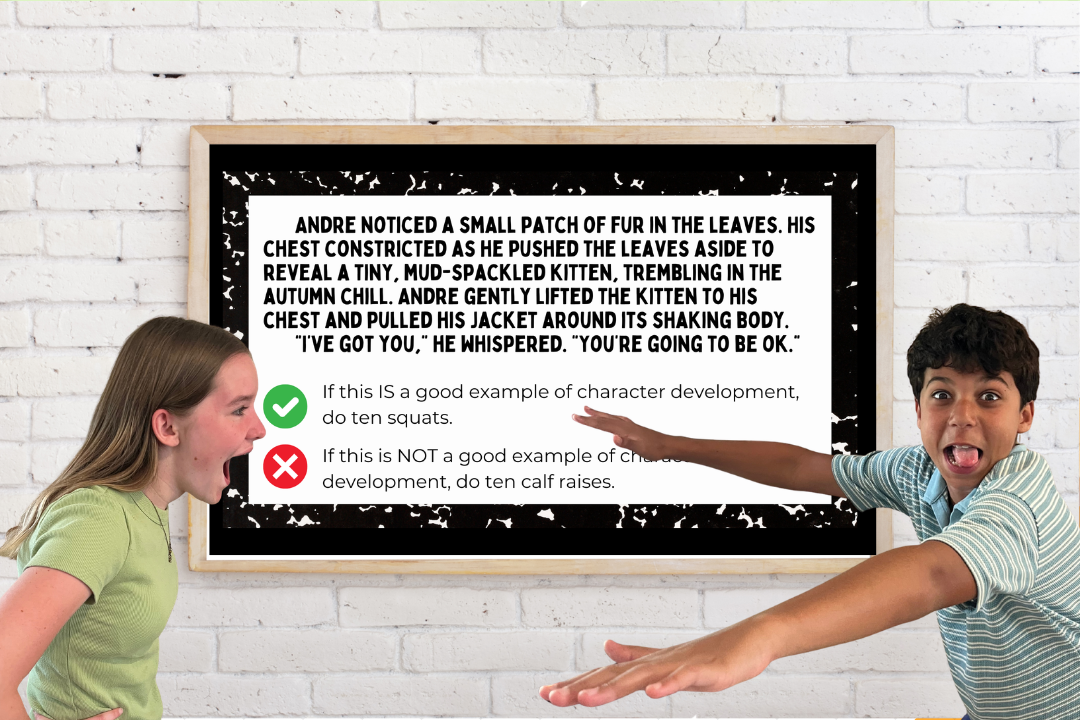
After seeing how much my seventh graders loved using Write Bites in the classroom, I knew I wanted to create a set specifically for narrative writing.
These short, focused writing activities give students opportunities to practice the individual skills they need to become stronger narrative writers.
And because they're broken down into manageable pieces, you don't have to turn every writing skill into a huge, multi-day lesson or wait until your next major narrative writing assignment to address it.
You can simply focus on one skill at a time.
One bite at a time.
Because students don't just know how to write a quality narrative.
They have to be taught.
And when we give them the tools they need, we give them a much better chance of becoming confident, capable writers.